The idea comes from Maria Montessori's approach to early childhood: arrange the child's room so the child can use it without asking an adult for help. A low shelf they can reach, a chair they can sit on, and a bed they can climb into and out of on their own.
A cot with high bars does the opposite. The child waits to be lifted in and lifted out. A floor bed puts the mattress almost at floor level, with a low guard around it and an open entrance, so getting up in the morning is something the child does, not something done to them.
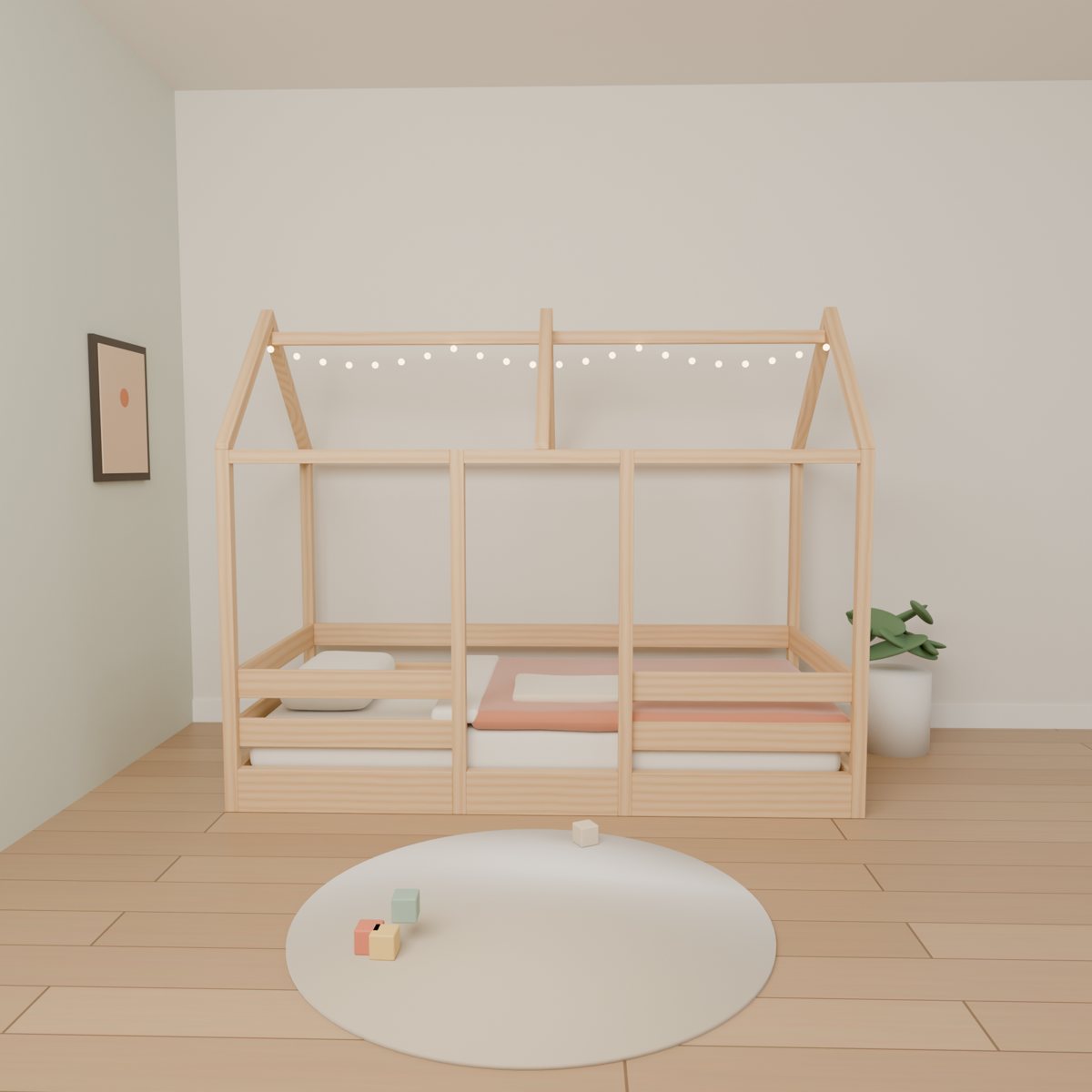
House frame or plain
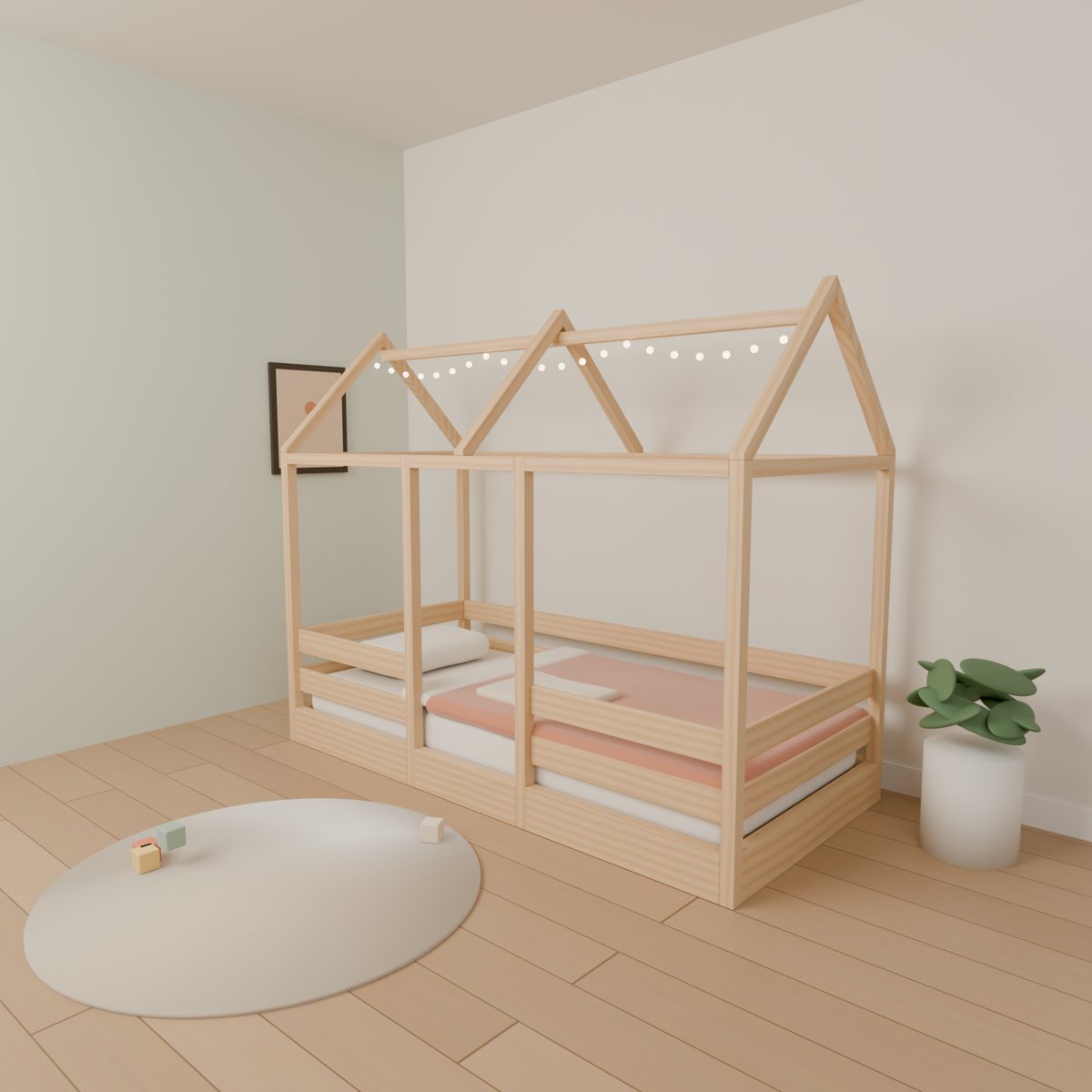
Most floor beds you see online have a house-shaped frame: four corner posts, a pitched roof made of rafters, and a ridge along the top. The roof does nothing structural. It is there because children love it, and because it is the perfect place for a string of lights or a light canopy.
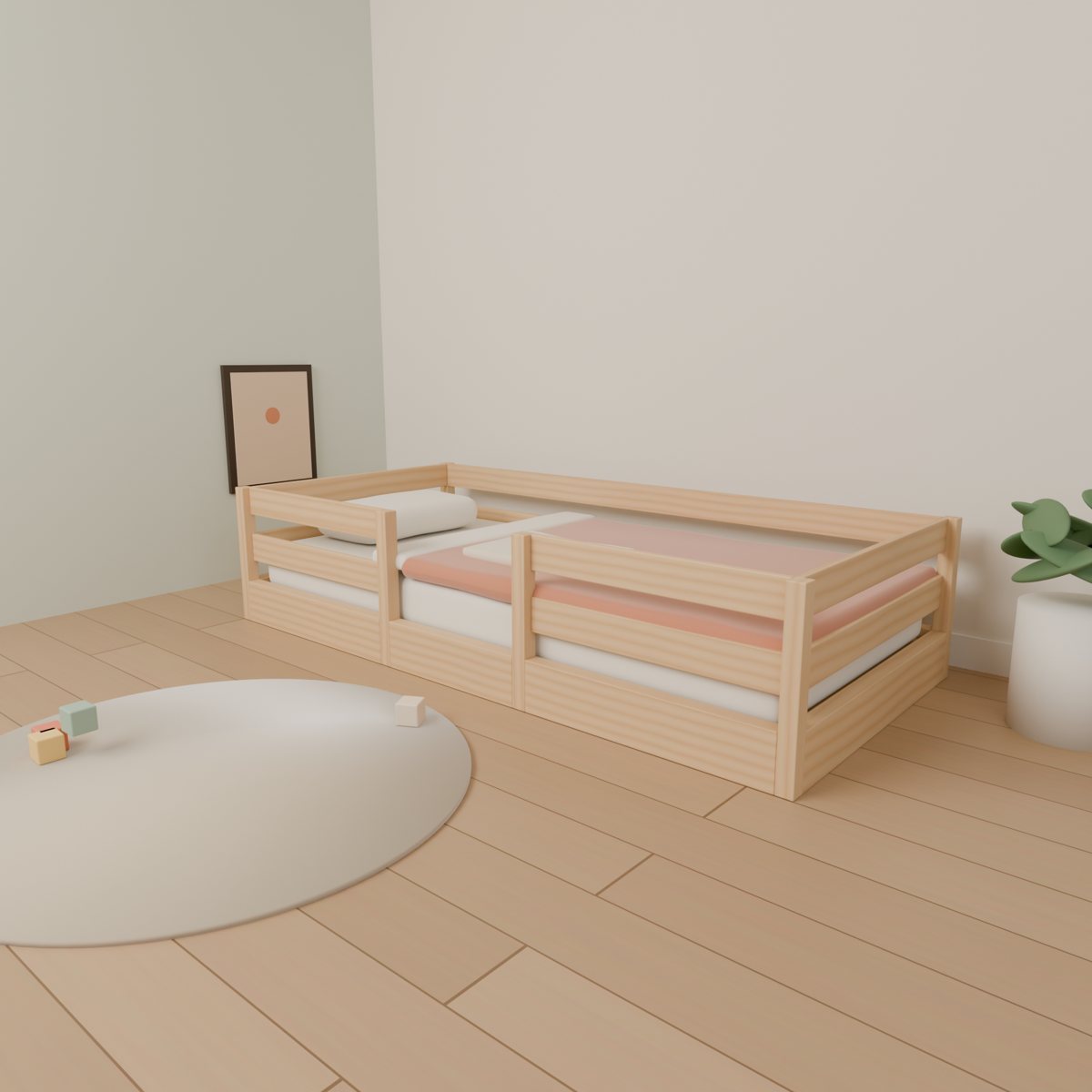
The plain version is the same bed without the roof: the low frame, the guard and the slats. It is quicker to build, uses less timber, and suits a room with a sloping ceiling or a child who is past the house stage.
Which size
A floor bed is built around a mattress, not the other way round. Buy or measure the mattress first, then build the frame to it.
| Mattress | Who it suits |
|---|---|
| 70 x 140 cm / US crib 28 x 52 in | The first floor bed, often straight from a cot mattress |
| 90 x 200 cm / US twin 38 x 75 in | A single bed the child will use for years |
| 140 x 200 cm / US full 54 x 75 in | A wide bed a parent can lie down in at story time |
The two smaller sizes need nothing under the slats except the cleats along the long sides. On the widest bed, a centre support running down the middle stops the slats from sagging.
The numbers that make it safe
A floor bed is low, so falls are not the main worry. Gaps are. A child can slide feet first through an opening that their head will not follow back out, and that is the danger every children's bed standard is written around.
Gaps in the guard. Children's bed standards (EN 716 in Europe, ASTM F1821 in the US) treat openings between about 89 mm (3.5 in) and 230 mm (9 in) as head-entrapment gaps. Keep every opening in the guard under the smaller figure. A good working number is 70 mm (2.75 in).
Guard height. The top of the guard should finish at least 127 mm (5 in) above the top of the mattress. That depends on the mattress, so decide the thickest mattress you will ever use and design to it. If you later put in a thicker one, the guard is suddenly too low.
Mattress fit. The inside of the frame should be the mattress plus no more than about 10 mm (3/8 in) on each side. A loose mattress leaves a gap along the edge that a small child can slip into. If you can fit two fingers between the mattress and the frame, the mattress is too small for the bed.
Slats. Keep the gaps between slats to 60 mm (2.5 in) or less, so the mattress is supported evenly and small feet do not go through when the mattress is off.
Guard faces. The guard boards should sit flush with the inside of the posts. Nothing should stick into the bed for a child to catch on.
The roof is decoration. It is not built to carry a child's weight. Do not hang swings, ropes or anything a child can pull on or climb from it, and keep the cords of lights and canopies out of reach.
Materials and finish
Floor beds are usually built from ordinary construction timber: square posts, a deeper section for the frame rails, and boards for the guard and the slats. Pocket-hole screws and glue are enough to hold it all together, so the tool list is short: a saw, a drill, a pocket-hole jig and a square.
Sand every edge to a small round. A child runs their hands along every edge of a bed like this. For the finish, use one sold as safe for toys or children's furniture (EN 71-3 in Europe, ASTM F963 in the US): a water-based lacquer, a hardwax oil, or no finish at all.
Before a child sleeps in it
Measure every gap in the guard. Do not assume. Check that no screw tip comes through any surface, that the mattress fills the base from edge to edge, and that the bed does not rack when you push a corner post. Then round off anything sharp you missed.
Build the floor bed in your mattress size
Fourteen sheets in metric and in imperial for three mattress sizes, the guard rail safety section and an Excel calculator for every cut, the lumber and the screws.
Get the floor bed plans · €11