Indoor lights and outdoor lights often look identical on the shelf. The difference is in the seals, the cable and the transformer, and you only find it on the label.
Read the IP rating
The IP code tells you how well something is sealed. The first digit is protection against solids, the second against water. For lights outside, the second digit is the one to read.
| Rating | What it means | Where it goes |
|---|---|---|
| IP20 | No protection against water | Indoors only |
| IP44 | Splashes from any direction | Outdoors under cover: a porch, under eaves |
| IP65 | Jets of water | Fully exposed: trees, railings, fences |
| IP67 | Brief immersion | Places where water can pool |
Every part of the set needs the rating, not just the bulbs: the cable, the controller box and the plug. A string labelled "for indoor use" stays inside, however sheltered the spot looks.
In Europe, also look for the CE mark and the name of a real manufacturer or importer on the box. In the US, look for a UL or ETL listing marked for outdoor use.
Choose LED, and low voltage if you can
LED strings use a fraction of the power of old filament bulbs, run almost cold, and survive knocks far better. Many outdoor sets run at low voltage (24 V or 31 V) from a transformer at the plug end. That is safer everywhere along the string, because only the transformer carries mains voltage. Check whether the transformer itself is rated for outdoors or has to stay inside, and follow the box.
The RCD is not optional
Every outdoor socket and every extension used outside should be protected by an RCD (a residual current device, also called a differential breaker; a GFCI in the US) rated at 30 mA. It cuts the power in a fraction of a second if current leaks to earth, through water or through a person.
Many newer homes have one on every circuit in the panel. If you're not sure, a plug-in RCD adapter between the socket and the extension does the same job for that one line. Press its test button at the start of the season.
Extension cables and plugs
- Use outdoor cable. In Europe, outdoor extension cables are usually rubber-sheathed (marked H07RN-F) with splash-proof sockets. A thin indoor extension with a plastic multi-socket does not belong outside, even for a night.
- Unroll cable reels fully. A coiled reel under load heats up.
- Keep connections off the ground. Water collects where a plug meets a socket. Hang the joint above ground level, or put it in a weatherproof connection box made for the purpose. Don't wrap it in a plastic bag; that traps condensation.
- Don't run cable through a closed window or door. The frame crushes the insulation. Use a flat window-pass cable, or an outdoor socket.
Joining strings
Many sets can be linked end to end, and the box gives the maximum number. Don't go past it. The first string in a chain carries the current for all the others, and the limit is there to keep it from overheating. Don't mix brands in one chain either, even if the plugs fit.
Hanging them
Use plastic clips or hooks made for lights. Never staple or nail through a cable, or tie it so tight the insulation is pinched. Avoid metal gutters and railings where the cable rubs on sharp edges; a cable that rubs all winter wears through.
If you work on a ladder, have someone hold it, and keep well away from overhead power lines.
Timers and the end of the season
A timer means the lights are never left on overnight by mistake, and saves power. Use an outdoor timer, or an indoor one on an indoor socket that feeds the outdoor cable. A dusk sensor switches them on as it gets dark.
Before you hang the lights each year, check every string on the floor: cracked insulation, a damaged plug, missing seals or a bulb that won't light all mean the set is finished. When the season is over, take them down, dry them and store them loosely coiled, not knotted.
This is general guidance. Any new outdoor socket or wiring in the panel is a job for a qualified electrician, following local regulations.
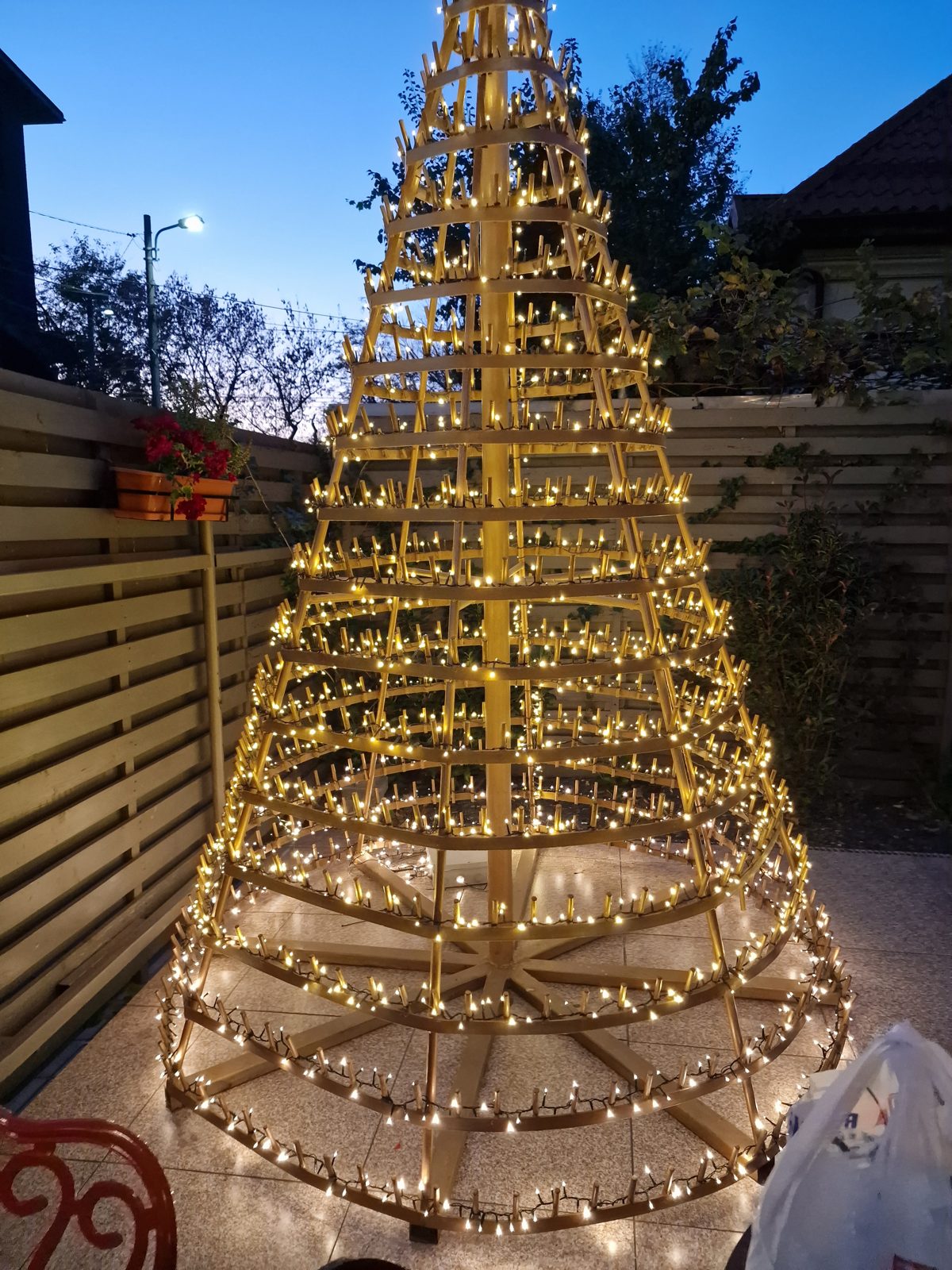
A tree that glows all winter
The bottle tree plans build a 10 ft steel tree you can wrap in lights or hang with coloured bottles. Read more about lighting it in [How to choose bottles for a bottle tree](/articles/bottle-tree-bottles-and-lights/).
Get the Bottle Tree plans · €32